Mississippi Freedom Trail Marker
William Chapel Church
Ruleville, MS
Unveiling and Dedication: February 22, 2013

Location: 800 O.B. Avenue, Ruleville, MS at the intersection of Elisha and Everette Langdon Street.
William Chapel Missionary Baptist Church and its pastor, Rev. J.D. Story played a significant role in the civil rights movement. It was at this church on August 27, 1962, that Fannie Lou Hamer attended her first mass meeting and later attempted to register to vote. This launched her foray into her fight for equal rights.Along with its civil rights history, William Chapel M.B. Church was also the site of Hamer’s funeral in March 1977. The eulogy was delivered by Andrew Young, then a U.S. delegate at the United Nations and attended by more than 400 people who crowded into the small building.The historic church was a regular meeting place for civil rights activists before the organization of the modern day movement. In 1962 the Reverend J. D. Story was the pastor when Student Nonviolent Coordinating Committee (SNCC) members came to Ruleville to start a voter registration drive. At the time, Ruleville in Sunflower County, was one of the most intractable areas of segregation.But Story was a courageous freedom fighter encouraging civil rights organizations to hold meetings there when other churches feared being firebombed. Mass meetings were held every Friday at 7:30 p.m. for a number of years, and the church was in fact firebombed after a civil rights rally in June 1964. Mary Tucker, a prominent figure in the Sunflower Freedom Movement and Hamer's good friend, was one of the founding trustees in 1922.Fannie Lou Hamer describes in the film, Fannie Lou Hamer’s America, how she learned she could vote.
As James Foreman, Reggie Robinson and James Bevel, a young colleague of Martin Luther King Jr, explained to the audience that they had a Constitutional right to vote., a local sharecropper named Fannie Lou Hamer was sitting in the audience. “They explained how it could change the different laws, like if we didn't want a law in the town or what was going on, we could vote them out,” Hamer said. “I thought it was the most remarkable thing that could happen in the state of Mississippi.”

More than 400 people crowded into the small church on Sunday, March 20, 1977 to attend Hamer’s funeral. There were so many speakers at her funeral, night fell and Hamer had to be buried the next day.
William Chapel (above) as it looked in 1962 when Fannie Lou Hamer attended her first mass meeting in Ruleville. And (above right) as it looks today. After Hamer was fired and kicked off the Marlow Plantation for trying to register to vote on August 31, she went to stay with Tucker and her husband Robert. Learning that Hamer was staying there, a would be assassin fired 16 bullets into their home. The bullets went through the wall right above where Hamer’s head would have been had she been sleeping there. Fortunately, when she learned her dear friends, the Tuckers were in danger, Hamer left their home and went to stay with a niece in Tallahatchie County, MS. 
The Marker in the church yard.
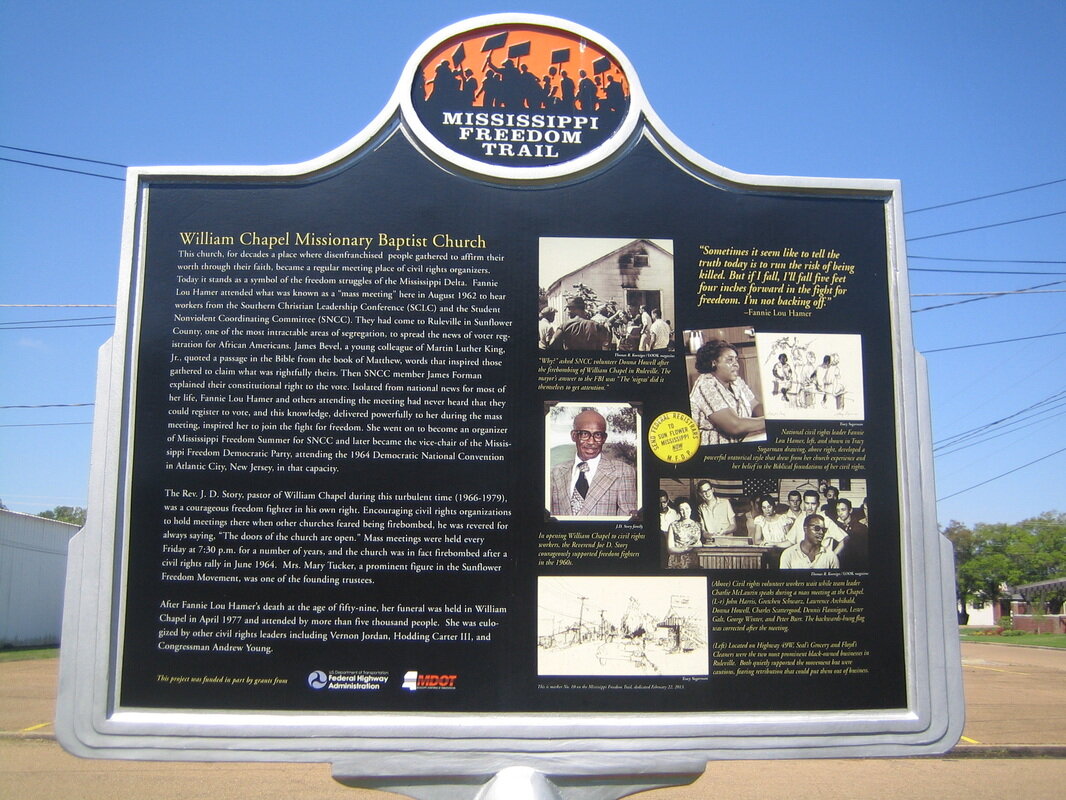
The back of the Marker that tells Hamer's story.

Original chairs from William Chapel.