
Fannie Lou Hamer’s Presidential Medal of Freedom Now on Display at the Two Mississippi Museums
JACKSON, Mississippi - February 10, 2026 - The Two Mississippi Museums are now displaying the Presidential Medal of Freedom awarded to civil rights leader Fannie Lou Hamer.
Fannie Lou Hamer’s Presidential Medal of Freedom was donated by her family to the Mississippi Department of Archives and History and is on display at the Mississippi Civil Rights Museum, part of the Two Mississippi Museums.“I am gratified that Aunt Fannie’s Presidential Medal of Freedom will be exhibited in the Mississippi Civil Rights Museum,” said her niece, Marilyn Mays. “Her courage and perseverance in the face of adversity are a shining example of patriotism and a reminder of our responsibility to safeguard our rights and freedoms for all and for future generations.”Fannie Lou Hamer’s niece, Marilyn Mays, speaks with Michael Morris (center), director of the Two Mississippi Museums, and Hamer’s cousin, Hinds County Tax Collector Eddie Fair (right) at the unveiling.
The Presidential Medal of Freedom - the highest honor granted to a civilian - was awarded posthumously to Hamer in January 2025 in recognition of her lasting impact on the Civil Rights Movement. One year after the award was conferred, the medal is now among a small number of Presidential Medals of Freedom associated with civil rights leaders that are accessible to the public. Hamer’s medal is on display in the “I Question America” gallery in the Mississippi Civil Rights Museum.
Monica Land, who is also Hamer’s niece and producer of the documentary Fannie Lou Hamer’s America, said the family chose to donate the medal so it could be shared publicly and encourage visitors to learn more about Hamer’s life, legacy and the sacrifices she made in the fight for voting rights.
"I am so happy we were able to gift this award to the museum and to the people of Mississippi," Land said. "Aunt Fannie Lou loved Mississippi and, hopefully, this donation will spark or further interest in her life and all that she fought so hard to accomplish for all people – not just Black people."
Land is also the project director for the digital Fannie Lou Hamer Educational Resource Center.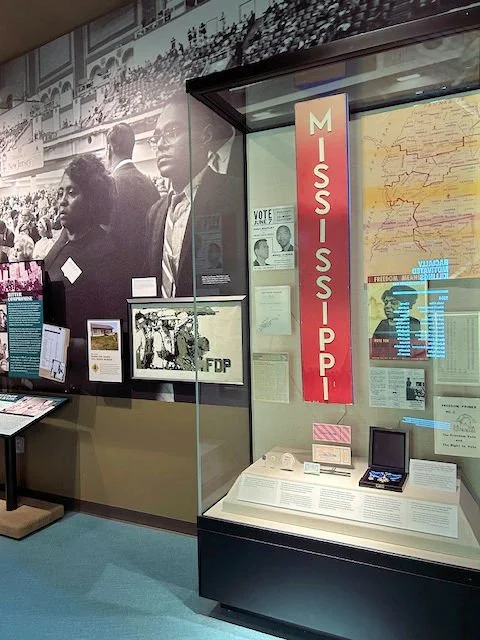
Hamer’s Medal Of Freedom is on display in the “I Question America” gallery in the Mississippi Civil Rights Museum featuring a photo (left) of Hamer and Bob Moses.
“Displaying Fannie Lou Hamer’s Presidential Medal of Freedom allows visitors to reflect on the extraordinary courage and influence of her activism,” said Michael Morris, director of the Two Mississippi Museums. “Presenting this medal at the Mississippi Civil Rights Museum is especially meaningful, as it connects a national honor to the place and movement that shaped her life’s work.”
Hamer is remembered for her leadership in the Civil Rights Movement, grounding her activism in the lived experiences of Black Mississippians. Her voice and actions resonated far beyond the state.
Born in 1917 in rural Mississippi, Hamer emerged as a leading advocate for voting rights after becoming involved with the Student Nonviolent Coordinating Committee in the early 1960s. Her nationally televised testimony before the credentials committee at the 1964 Democratic National Convention – often referred to as her “I Question America” speech – drew national attention to the violence and intimidation faced by Black Mississippians seeking to register to vote, and it helped galvanize support for the Voting Rights Act of 1965.
The Two Mississippi Museums – the Museum of Mississippi History and the Mississippi Civil Rights Museum – opened Dec. 9, 2017, in celebration of Mississippi’s bicentennial. The interconnected museums take visitors through the sweep of Mississippi history and the state’s central role in the nation’s Civil Rights Movement.
Museum hours are Tuesday through Saturday, 9 a.m. to 5 p.m., and Sunday, 11 a.m. to 5 p.m.
For more information, call 601-576-6850 or email info@mdah.ms.gov.